



Hearing your doctor mention the word “cancer” can immediately trigger fear and confusion. However, understanding the cancer diagnosis process empowers you to take control of your health. This guide breaks down exactly how doctors detect cancer early and what steps you should expect.
This comprehensive guide explores the complete cancer diagnosis process, from identifying initial symptoms to undergoing advanced imaging and biopsies. You will learn about various diagnostic tools, the importance of early detection, and how to navigate consultations with specialists. By avoiding common pitfalls and applying our expert insights, you can approach your medical journey with confidence and clarity.
Understanding the Cancer Diagnosis Process
The cancer diagnosis process rarely happens in a single day. It typically unfolds over several weeks, involving multiple healthcare professionals, detailed lab work, and advanced technology. The primary goal of this procedure is to determine if abnormal cells are present, identify their origin, and assess whether they have spread to other parts of the body. When doctors catch these abnormalities early, patients gain access to a wider variety of treatment options and experience significantly better survival rates.
Initial Warning Signs and Symptoms
Most diagnostic journeys begin when a patient notices something unusual about their body. Symptoms vary widely depending on the type and location of the disease. You might experience persistent fatigue, unexplained weight loss, chronic pain, or notice a new lump beneath your skin. While these symptoms frequently relate to benign conditions, you must never ignore them. Recognizing these physical changes represents the critical first step in early cancer detection.
Doctors rely heavily on your personal observations during the initial consultation. Keeping a detailed symptom journal helps your medical team understand the timeline and severity of your condition. Document when symptoms start, how often they occur, and whether they change over time. This proactive approach gives your physician a clearer picture and accelerates the overall cancer diagnosis process.
Primary Care Consultation
Your primary care provider serves as the gatekeeper to the cancer diagnosis process. During your initial visit, your doctor will conduct a thorough physical examination and review your complete medical history. They will ask questions about your lifestyle, previous health issues, and family history of disease. Genetic factors play a massive role in cancer risk, so knowing whether your parents or siblings faced similar health challenges provides vital clues.
If your doctor spots anything suspicious during the exam, they will order preliminary tests. These might include basic blood work or simple imaging scans. If these initial results indicate potential abnormalities, your primary care provider will refer you to an oncology cancer care team for specialized evaluation. This transition marks the shift from general observation to targeted clinical investigation.
Key Screening and Imaging Tests for Cancer
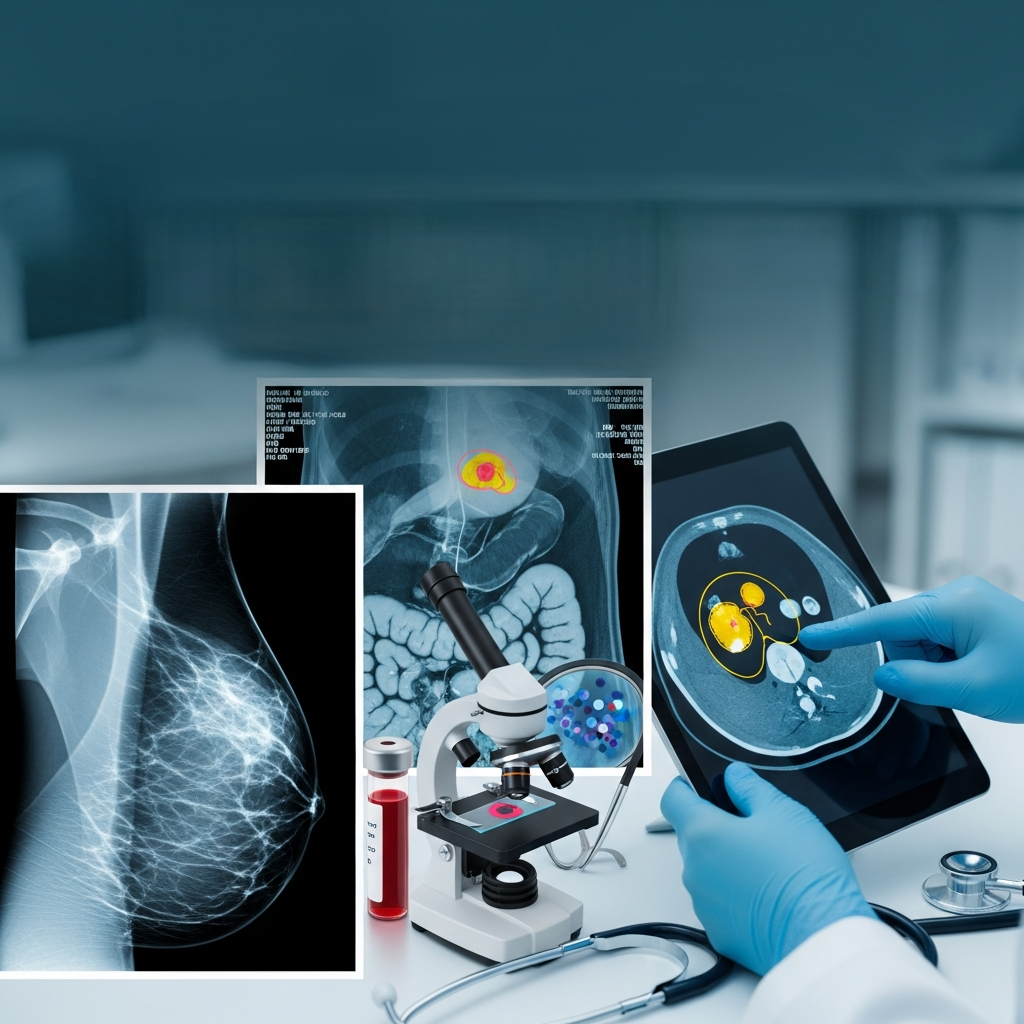
Screening tests help doctors find cancer before you even experience symptoms. Preventive medicine relies heavily on these tools to catch diseases in their earliest, most treatable stages. Once symptoms appear or a screening test raises a red flag, doctors use specialized imaging tests for cancer to look inside your body without making a single incision.
Mammograms, CT Scans, and MRIs
Mammograms are specialized, low-dose X-rays designed specifically to examine breast tissue. Health organizations strongly recommend regular mammograms for women starting in their 40s, as they remain the gold standard for detecting breast cancer early. If a mammogram shows a suspicious mass, doctors will likely order additional imaging to get a clearer view.
Computed Tomography (CT) scans take multiple X-ray images from different angles and combine them to create cross-sectional views of your bones, blood vessels, and soft tissues. CT scans provide much more detail than standard X-rays, making them incredibly useful for spotting tumors in the lungs, liver, and pancreas.
Magnetic Resonance Imaging (MRI) uses powerful magnets and radio waves to produce highly detailed images of your internal organs. Unlike CT scans, MRIs do not use radiation. Doctors frequently use MRIs to examine the brain, spinal cord, and musculoskeletal system. These imaging tools form a cornerstone of the cancer diagnosis process, helping oncologists pinpoint exactly where a tumor resides.
PET Scans and Ultrasound
Positron Emission Tomography (PET) scans offer a unique perspective by revealing how your tissues and organs function on a cellular level. Before a PET scan, a technician injects a small amount of radioactive sugar into your bloodstream. Because cancer cells grow rapidly and consume more energy than normal cells, they absorb more of this sugar. The scanner detects these “hot spots,” allowing doctors to see active cancer growth and determine if the disease has metastasized (spread).
Ultrasound uses high-frequency sound waves to create real-time images of the inside of your body. It serves as an excellent, non-invasive tool for examining soft tissues and distinguishing between solid tumors and fluid-filled cysts. Doctors commonly use ultrasound to guide needles during biopsy procedures, ensuring they collect tissue from the exact center of a suspicious mass.
Laboratory Tests and Tumor Markers

While imaging scans show where a tumor lives, laboratory tests tell doctors what the tumor is doing. Analyzing your blood, urine, and other bodily fluids provides essential clues that drive the cancer diagnosis process forward.
Blood Tests and Urinalysis
A Complete Blood Count (CBC) measures the amount of different types of cells in your blood. Leukemia and other blood cancers often cause highly abnormal CBC results. Urinalysis can detect blood in your urine, which might indicate bladder or kidney cancer, even if the blood remains invisible to the naked eye.
Doctors also look for specific tumor markers in your blood. Tumor markers are proteins or other substances produced at higher-than-normal levels by cancer cells. For example, a high Prostate-Specific Antigen (PSA) level might indicate prostate cancer. However, because non-cancerous conditions can also elevate these markers, doctors rarely use them as the sole basis for a diagnosis. Instead, they use them to monitor how well a patient responds to treatment or to check for cancer recurrence.
The Role of Multi-Cancer Early Detection (MCED) Tests
Medical science constantly evolves, bringing new technologies to the cancer diagnosis process. Multi-Cancer Early Detection (MCED) tests represent one of the most exciting advancements in recent years. These specialized blood tests use artificial intelligence and machine learning to analyze DNA fragments shed by tumors into the bloodstream.
MCED tests can potentially detect dozens of different cancer types from a single blood draw, including cancers that currently lack standard screening methods, like pancreatic or ovarian cancer. While MCED tests are not yet a replacement for traditional screenings like colonoscopies or mammograms, they offer a powerful supplementary tool for high-risk patients. If an MCED test returns a positive result, doctors will immediately initiate a more traditional cancer diagnosis process to locate and confirm the disease.
Biopsies: The Definitive Step in the Cancer Diagnosis Process
Imaging scans and blood tests can strongly suggest the presence of cancer, but they cannot provide absolute certainty. A biopsy remains the only definitive way to confirm a cancer diagnosis. During this procedure, a doctor removes a small sample of tissue from the suspicious area. A specialized doctor called a pathologist then examines the cells under a microscope to determine if they are malignant (cancerous) or benign (non-cancerous).
Needle Biopsies vs. Surgical Biopsies
Doctors choose a biopsy method based on the tumor’s size, location, and accessibility. Fine Needle Aspiration (FNA) uses a very thin needle attached to a syringe to withdraw a small amount of tissue or fluid. Core needle biopsies use a slightly larger needle to extract a small cylinder of tissue. Both methods are minimally invasive and typically require only local anesthesia.
If a needle biopsy does not yield enough tissue for a clear diagnosis, or if the tumor sits deep within the body, a doctor might perform a surgical biopsy. An incisional biopsy removes a piece of the tumor, while an excisional biopsy attempts to remove the entire tumor along with a margin of healthy surrounding tissue. Surgical biopsy procedures require more recovery time but provide pathologists with a larger sample to study.
Liquid Biopsies
Liquid biopsies represent a revolutionary, minimally invasive approach to the cancer diagnosis process. Instead of extracting solid tissue, doctors draw a standard blood sample to look for circulating tumor cells or bits of tumor DNA. While still emerging, liquid biopsies help oncologists profile the genetic makeup of a tumor, enabling them to select highly targeted therapies without subjecting the patient to repeated surgical procedures.
Staging and Grading: What Happens After Detection?
Once a biopsy confirms the presence of cancer, the next crucial step in the cancer diagnosis process involves determining the extent of the disease. This is known as staging. Staging helps your oncology cancer care team understand how large the primary tumor has grown and whether it has spread to lymph nodes or distant organs.
Most cancers are staged on a scale of I to IV. Stage I indicates a small, localized tumor, while Stage IV signifies that the cancer has metastasized to other parts of the body. Accurate staging dictates the entire treatment plan, whether that involves surgery, radiation, chemotherapy, or immunotherapy.
Pathologists also assign a “grade” to the cancer cells based on how abnormal they look under a microscope. Low-grade cancers look similar to healthy cells and tend to grow slowly. High-grade cancers look highly abnormal and tend to spread rapidly. Combining the stage and grade gives your doctor the clearest possible picture of your prognosis.
Expert Insights on Navigating Your Health Journey

Facing the cancer diagnosis process requires mental and emotional resilience. We consulted leading oncologists to gather practical advice for patients entering this challenging phase of life.
- Bring a Support Person: Never attend crucial diagnostic appointments alone. A trusted friend or family member can take notes, ask clarifying questions, and provide essential emotional support when you feel overwhelmed.
- Seek a Second Opinion: A cancer diagnosis changes your life. It is entirely appropriate and often encouraged to seek a second opinion from another qualified specialist. Different institutions may have access to distinct clinical trials or diagnostic technologies.
- Stay Organized: You will receive a massive amount of paperwork, test results, and scheduling information. Keep a dedicated binder or digital folder for all your medical records. This organization reduces stress and ensures you always have the necessary information at your fingertips.
- Communicate Openly: Do not hide symptoms or side effects from your medical team. Even minor changes can provide vital diagnostic clues. Total transparency ensures you receive the highest quality of care.
Common Mistakes to Avoid During Diagnosis
Navigating the healthcare system can be tricky. Avoid these common pitfalls to ensure your cancer diagnosis process proceeds as smoothly as possible.
- Relying on Dr. Google: While researching your symptoms is natural, the internet is filled with worst-case scenarios and misinformation. Trust your medical team and verified, high-authority sources like the American Cancer Society or the National Cancer Institute.
- Skipping Follow-Up Appointments: If a screening test returns an abnormal result, you must attend the follow-up imaging or biopsy appointment. Delaying these steps allows potential cancers to grow unchecked.
- Ignoring Mental Health: The anxiety of waiting for test results can be debilitating. Do not ignore your emotional well-being. Ask your doctor for a referral to an oncology social worker or counselor who specializes in helping patients navigate diagnostic anxiety.
Comparison Table: Imaging Tests vs. Biopsy Procedures
To help clarify the different tools used in the cancer diagnosis process, review this breakdown of how imaging and biopsies work together.
|
Feature |
Imaging Tests (CT, MRI, PET) |
Biopsy Procedures (Needle, Surgical) |
|---|---|---|
|
Primary Purpose |
Locate abnormalities, determine tumor size, and check for spread. |
Extract tissue to definitively confirm the presence of cancer cells. |
|
Invasiveness |
Non-invasive (mostly requires lying still inside a scanner). |
Minimally invasive to surgical (requires needles or incisions). |
|
Anesthesia Needed |
Rarely needed, though sedatives may be used for claustrophobia. |
Requires local or general anesthesia depending on the method. |
|
What it Tells the Doctor |
Where the tumor is and how far it reaches. |
What the tumor is (benign vs. malignant, cell type, and grade). |
Ultimately, imaging tests point the medical team in the right direction, but the biopsy serves as the undeniable proof needed to finalize the cancer diagnosis process and begin life-saving treatment.
Conclusion
Understanding the cancer diagnosis process removes much of the fear associated with an abnormal screening result. By recognizing early symptoms, utilizing advanced imaging, and securing a definitive biopsy, doctors can identify disease when it is most treatable. If you notice persistent changes in your health or are due for a routine screening, take action today. Schedule an appointment with your primary care provider immediately to protect your long-term health.
