


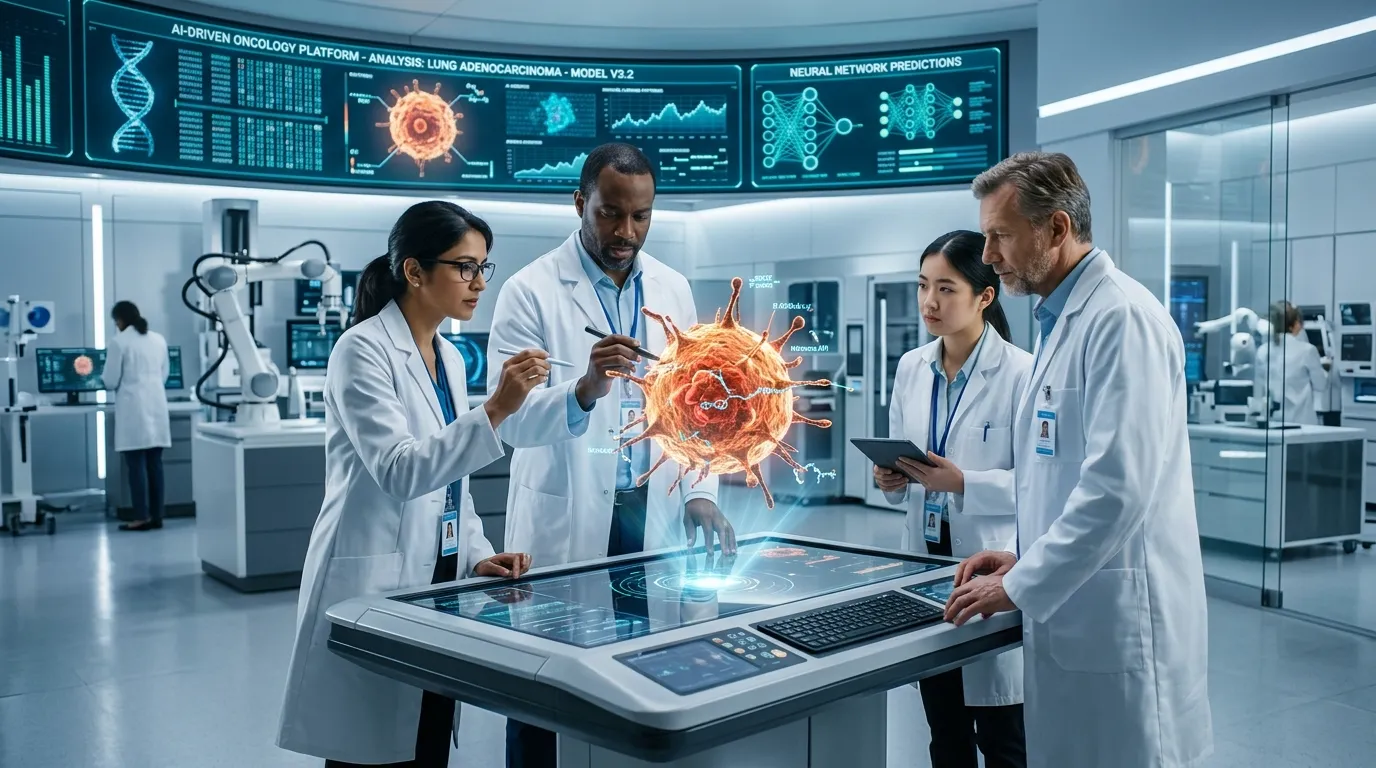
AI-driven cancer treatment is reshaping how clinicians detect, classify, and treat tumors. By analyzing imaging, pathology, and molecular data at scale, these tools surface patterns humans miss. This article explains how the technology works, where it delivers value, and what still stands between promise and routine bedside practice.
This guide breaks down how artificial intelligence improves cancer diagnostics, treatment planning, and survival prediction. You will learn the core technologies behind it, real clinical examples, a comparison of traditional versus AI-assisted care, common mistakes, and expert tips. We also tackle the underexplored issues—workflow disruption, data quality, interpretability, and regulation—so you finish with a complete, practical picture.
What AI-Driven Cancer Treatment Really Means
AI-driven cancer treatment refers to using machine learning and deep learning systems to support decisions across the entire cancer care pathway. That pathway runs from screening and diagnosis to therapy selection, monitoring, and follow-up. The goal is not to replace oncologists but to give them a faster, sharper assistant.
At its heart, the technology processes huge, messy datasets and finds signals tied to outcomes. The World Health Organization recorded roughly 20 million new cancer cases and 9.7 million deaths in 2022, with numbers expected to climb. Traditional methods struggle to keep pace with that volume and the complexity of modern data. AI fills the gap.
Three capabilities define the field:
- Pattern recognition in images, slides, and sequences that humans cannot scan at scale
- Predictive analytics that forecast survival, recurrence, and therapy response
- Data integration that links genomic profiling, imaging, and clinical records into one model
A review in Frontiers in Oncology framed it simply: AI bridges the distance between raw biological data and the clinic. That bridge is what turns information into better care.
The Core Technologies Powering Smarter Cancer Care
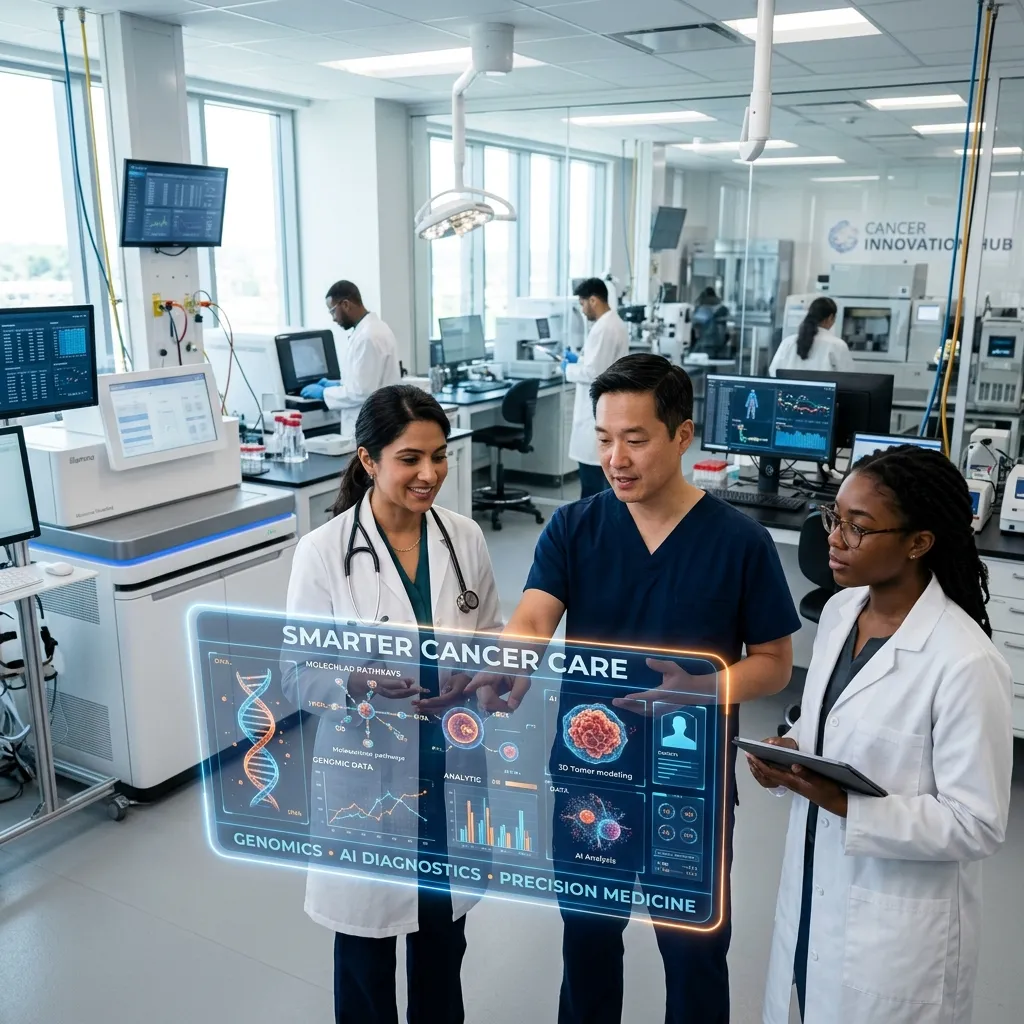
Understanding the engine helps you judge the hype. Most advances trace back to a few methods, each suited to a different kind of cancer data.
Machine Learning and Deep Learning Foundations
Machine learning trains algorithms to map inputs to outputs. Supervised models learn from labeled data, such as scans tagged as malignant or benign. Unsupervised models find hidden clusters, revealing tumor subtypes nobody defined in advance. Reinforcement learning, meanwhile, learns through feedback and shows promise for adaptive radiotherapy.
Deep learning uses layered neural networks to handle unstructured data. Convolutional neural networks excel at images, making them ideal for radiology and digital pathology. Transformer and attention-based models, borrowed from language processing, now integrate multiple data types into single predictive systems.
Radiomics and Imaging Intelligence
Radiomics extracts hundreds of quantitative features—texture, shape, intensity—from CT, MRI, and PET scans. Many of these features are invisible to the human eye. When paired with AI, they become biomarkers that predict prognosis or therapy response. Studies in Radiology have shown deep learning reconstructing ultra-low-dose CT images with less noise and better nodule detection, cutting radiation exposure while improving accuracy.
Multi-Omics and Molecular Modeling
Multi-omics combines genomics, transcriptomics, proteomics, and metabolomics. No single layer tells the full story of a tumor. Integrating them gives a fuller view of cancer biology. AI handles this high-dimensional data well, supporting biomarker discovery, drug-target identification, and refined molecular subtyping that guides personalized medicine.
How AI Improves Diagnosis and Early Detection
Diagnosis is where AI has made the loudest impact, and for good reason. Accuracy here shapes every downstream decision.
Radiology and Image-Based Detection
AI models detect, localize, and characterize tumors with striking precision. In breast cancer screening, the ScreenTrustMRI trial, published in Nature Medicine, used AI to flag high-risk patients with negative mammograms for supplemental MRI—catching cancers that would have been missed. Lung cancer screening tools now reduce false negatives and even predict nodule growth.
Early detection is the most powerful weapon against cancer. Harvard-affiliated research highlighted by the Cancer Research Institute showed AI predicting pancreatic cancer risk from millions of patient records, flagging high-risk individuals using disease codes not obviously tied to the pancreas.
Digital Pathology Transformation
Roughly a billion slides are created yearly, and as Inside Precision Medicine reported, about 85% are still read on glass under a microscope. Digital pathology changes that. Paige Prostate Detect became the first FDA-approved AI diagnostic in this space. Foundation models like Atlas, trained on millions of whole-slide images from the Mayo Clinic and Charité, now power tumor classification, biomarker quantification, and outcome prediction with far less task-specific data.
Molecular and Genomic Diagnostics
AI interprets next-generation sequencing data to flag driver mutations and classify tumors. Tools such as CUP-AI-Dx and OncoOrigin tackle cancers of unknown primary, predicting the tissue of origin with high accuracy. This matters because the right diagnosis unlocks the right targeted therapy.
AI-Driven Cancer Treatment Planning and Clinical Decisions
Beyond diagnosis, AI now shapes how therapy gets designed and delivered. This is where AI-driven cancer treatment moves from insight to action.
Radiotherapy and Treatment Optimization
Deep learning automates tumor contouring and dose prediction, slashing planning time and reducing variability between clinicians. A prospective study in the International Journal of Radiation Oncology found that 93% of machine-assisted brain radiotherapy plans were clinically acceptable, with faster turnaround. Reinforcement learning models adapt plans dynamically as tumors respond.
Clinical Decision Support Systems
Clinical decision support tools integrate patient data to recommend therapies and predict response. A random forest model predicted neoadjuvant breast cancer outcomes with 80% accuracy. More recently, an autonomous oncology agent built on a large language model, reported in Nature Cancer, correctly used specialized tools in 87.5% of complex cases and reached accurate conclusions in 91%—far outperforming the base model alone.
Drug Discovery and Immunotherapy
AI compresses drug discovery timelines. Generative models design new molecules, predict binding affinity, and model toxicity. AlphaFold2 reshaped protein-structure prediction, speeding target identification. In immunotherapy, machine learning predicts peptide-MHC binding to design personalized tumor vaccines, offering hope for glioblastoma and other hard-to-treat cancers.
Traditional Care Versus AI-Assisted Care: A Comparison
The table below clarifies where AI adds value and where human judgment stays essential.
|
Dimension |
Traditional Approach |
AI-Assisted Approach |
|---|---|---|
|
Image review |
Manual, time-intensive, observer variability |
Automated detection, consistent, scalable |
|
Diagnosis speed |
Days to weeks |
Minutes to hours for flagged findings |
|
Data integration |
Siloed by specialty |
Combines imaging, omics, and records |
|
Risk prediction |
Population-based scores |
Individualized, multifactorial models |
|
Rare cancers |
Limited expertise outside major centers |
Foundation models extend reach |
|
Cost per insight |
High for genetic testing |
Lower using inexpensive H&E slides |
|
Final decision |
Clinician-led |
Clinician-led with AI support |
The pattern is clear. AI accelerates and broadens analysis, but the oncologist still owns the decision. Tools assist; they do not replace.
The Underexplored Challenges Holding Adoption Back

Most articles stop at the wins. The honest picture includes friction that determines whether these tools reach patients.
Data Quality and Standardization
AI is only as good as its training data. Imaging produced on different machines, slides stained with different dyes, and noisy omics data all create bias. The Frontiers review stressed that disordered, non-standard data lowers model robustness and limits generalization. Without standardized, representative datasets, models that shine in one hospital fail in another.
Model Interpretability
Many powerful models behave like black boxes. Clinicians struggle to trust outputs they cannot explain. Techniques such as SHAP and LIME help reveal which features drive a prediction, but interpretability remains a barrier to adoption, especially in high-stakes oncology decisions where accountability matters.
Clinician Workflow Impact
Adoption fails when tools disrupt the way clinicians actually work. A model that adds clicks, demands new infrastructure, or interrupts established routines gets abandoned. Successful deployments fit into existing workflows—acting as a first reader, triage step, or quiet second opinion rather than a parallel system.
Regulation and Accountability
Existing frameworks were built for static devices, not adaptive software that learns over time. The FDA and the European Medicines Agency now demand external, multi-center validation, predefined change-control plans, and post-market surveillance. Liability also stays murky: if an algorithm errs, who is responsible? These questions slow the move from research to routine use.
Equity and Access
Models trained on narrow populations can underperform for underrepresented groups. Skin lesion classifiers trained on limited skin types diagnose those patients poorly. Yet AI also democratizes care. As Inside Precision Medicine noted, a $5 digitized slide could deliver insights that once required expensive genetic tests, extending high-quality care to rural and regional hospitals.
Patient-Centered Outcomes That Actually Matter
Technology means little if patients do not feel the benefit. AI-driven approaches improve outcomes in concrete ways. They reduce unnecessary biopsies, as in the thyroid case reported by the AAMC where AI-guided ultrasound avoided an invasive procedure. They shorten anxious waiting periods through faster reads. They personalize therapy, sparing patients from treatments unlikely to help. NCI and NIH research consistently links earlier, more accurate diagnosis to better survival and quality of life. The real measure of success is not model accuracy alone but fewer side effects, faster answers, and longer, fuller lives.
Common Mistakes to Avoid
Teams adopting AI in cancer care repeatedly stumble on the same issues. Avoid these.
- Treating AI as a replacement for clinicians. It is an assistant. The oncologist makes the final call and carries responsibility.
- Ignoring data quality. Feeding models biased or non-standardized data guarantees unreliable results that fail outside the lab.
- Skipping external validation. A model that works on one dataset may collapse on another. Validate across institutions before trusting outputs.
- Overlooking interpretability. Deploying black-box tools without explanation methods erodes clinician trust and complicates accountability.
- Forgetting workflow fit. Tools that disrupt routines get abandoned, no matter how accurate.
- Neglecting equity. Unrepresentative training data produces discriminatory performance across ethnic and demographic groups.
- Assuming approval equals adoption. Regulatory clearance is the start, not the finish, of clinical integration.
Expert Insights and Pro Tips
Drawing on patterns across peer-reviewed reviews and leading cancer centers, these tips separate hype from real value.
First, start with a narrow, high-impact problem. Foundation models are powerful, but the fastest wins come from well-defined tasks like prostate detection or mitosis counting. Second, favor hybrid models. Research in Frontiers shows that combining traditional machine learning with deep learning improves interpretability and performance over either alone. Third, build multimodal pipelines deliberately. Linking digital pathology with genomic profiling and clinical data, as Tempus and Mayo Clinic are doing, surfaces insights no single source reveals. Fourth, plan for continuous retraining. Patient populations and protocols evolve, and a model left unmaintained degrades. Finally, keep clinicians in the loop from day one. Marilyn Bui at Moffitt Cancer Center prefers the term “augmented intelligence”—tools that enhance human judgment rather than override it. That framing drives adoption because it respects expertise.
The Road Ahead for AI in Oncology
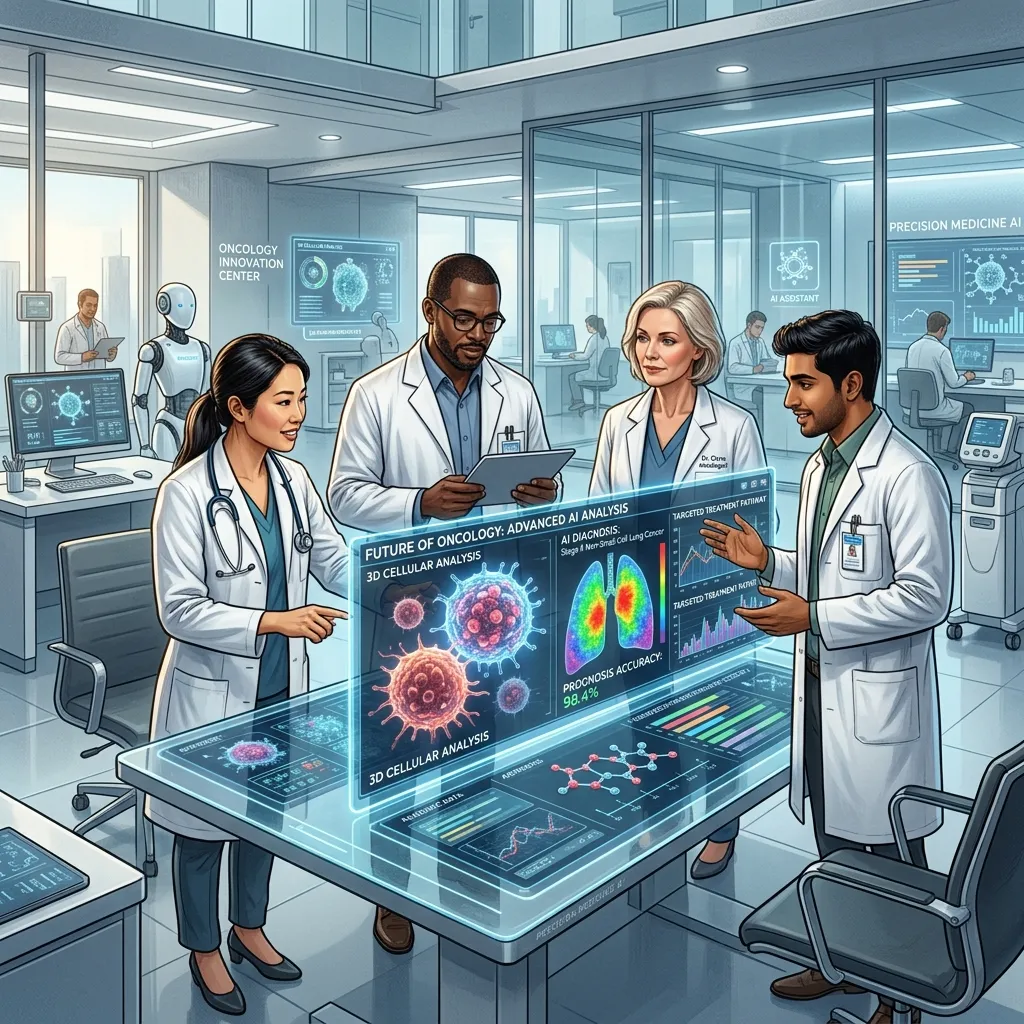
The trajectory points toward deeper integration. Foundation models will keep expanding, with systems like Atlas2 reaching billions of parameters trained on millions of slides. Vision-language models will let clinicians query a slide in plain language—”circle the tumor area”—as if speaking to a colleague. Multimodal platforms will fuse imaging, omics, and outcomes into unified models for both common and rare cancers.
Inside Precision Medicine predicts most pathology workflows will be digital within a decade, driven by cheaper, faster scanners. As that infrastructure spreads, AI tools become easy to deploy anywhere. The endgame is not flashier algorithms but broader, fairer access to expert-level care. Patients in small towns could receive insights once reserved for major academic centers. That shift, more than any single breakthrough, defines the promise of the field.
Conclusion
AI-driven cancer treatment is no longer a distant promise—it is reshaping detection, diagnosis, and therapy today. The technology sharpens precision, supports better clinical decisions, and improves patient outcomes when paired with strong data, clear interpretability, and human oversight. Explore how these tools fit your practice or research, and stay engaged as the field advances toward broader, fairer cancer care.
Frequently Asked Questions
1. What is AI-driven cancer treatment?
It is the use of artificial intelligence—mainly machine learning and deep learning—to support cancer care across screening, diagnosis, therapy planning, and monitoring. These systems analyze imaging, pathology slides, and molecular data to find patterns tied to outcomes, helping clinicians make faster, more accurate decisions while keeping the final call in human hands.
2. Can AI replace oncologists and pathologists?
No. Experts consistently describe AI as augmented intelligence, not a replacement. It handles tasks humans cannot do at scale, such as scanning thousands of data points or reviewing slides rapidly. The clinician interprets results, applies context, makes the diagnosis, and carries responsibility. AI assists; it does not decide.
3. How does AI improve early cancer detection?
AI spots subtle features in scans and records that humans often miss. It flags high-risk patients for additional screening, reduces false negatives, and predicts risk from large datasets. Research has shown AI predicting pancreatic cancer risk from patient records and improving breast and lung cancer screening accuracy, enabling earlier, more effective intervention.
4. What is digital pathology and why does it matter?
Digital pathology converts glass tissue slides into high-resolution images that AI can analyze. It enables consistent tumor grading, biomarker quantification, and faster review. It also democratizes access, since an inexpensive digitized slide can deliver insights that once required costly genetic testing, extending expert-level diagnosis to smaller hospitals.
5. How accurate are AI cancer diagnostic tools?
Accuracy varies by task, but many tools match or exceed expert performance in specific areas. Studies report ROC-AUC scores above 0.95 for some classification and tissue-of-origin tasks. However, accuracy depends heavily on data quality and external validation. A model strong in one setting may underperform elsewhere without proper testing.
6. What are the biggest barriers to adoption?
Key barriers include poor data quality and standardization, limited model interpretability, workflow disruption, evolving regulation, accountability questions, and equity concerns. Adaptive AI also challenges frameworks built for static devices. Overcoming these requires representative datasets, explainable models, clinician-friendly design, and robust validation and surveillance.
7. How does AI support cancer treatment planning?
AI automates radiotherapy contouring and dose prediction, reducing planning time and variability. Clinical decision support systems recommend therapies and predict response by integrating patient data. Reinforcement learning adapts plans as tumors change. These tools improve consistency and personalization while clinicians retain oversight of complex cases and final decisions.
8. Does AI play a role in drug discovery and immunotherapy?
Yes. AI accelerates drug discovery by screening chemical libraries, predicting binding affinity, and designing new molecules, cutting timelines significantly. AlphaFold2 advanced protein-structure prediction. In immunotherapy, machine learning predicts neoantigen targets to design personalized tumor vaccines, offering new options for aggressive cancers like glioblastoma where standard treatments often fail.
9. Is patient data safe with AI cancer tools?
Data safety is a serious concern. Cancer AI relies on sensitive imaging, genomic, and health-record data. Genomic data carries extra risk because it can enable indirect identification. Responsible use demands strong de-identification, secure storage, compliant data-sharing frameworks, and federated learning approaches that protect privacy while still training effective models.
10. How is AI-driven cancer treatment regulated?
Most tools are regulated as software as a medical device. The FDA uses a risk-based framework, while the EU applies the Medical Device Regulation and the AI Act. Regulators require analytical and clinical validity, multi-center validation, and post-market monitoring. Adaptive models that learn over time add complexity, prompting lifecycle-based oversight approaches.
