



A cancer diagnosis often brings a confusing wave of medical jargon. This comprehensive Breast Cancer Glossary provides clear, straightforward definitions. By translating complex clinical terms into everyday language, we help you understand your pathology reports and treatment options with confidence.
This guide breaks down essential breast cancer terminology. We cover everything from anatomical structures and screening methods to staging, grading, and treatment protocols. You will learn how to read your medical charts, avoid common misunderstandings, and make informed decisions alongside your medical team using this extensive resource.
Why Every Patient Needs a Reliable Breast Cancer Glossary
Navigating the healthcare system requires learning an entirely new language. When doctors speak in clinical terms, patients can easily feel overwhelmed or left in the dark. A dedicated Breast Cancer Glossary serves as a critical translation tool between you and your oncology team. Understanding these terms gives you the power to ask the right questions, comprehend your diagnosis, and actively participate in building your treatment plan. Instead of passively receiving information, you become an educated advocate for your own health. Knowing the specific vocabulary used in your pathology reports removes the fear of the unknown, allowing you to focus your energy on healing and recovery rather than confusion.
Decoding Medical Jargon for Patients
Medical professionals use precise language to describe cellular changes, tumor characteristics, and treatment protocols. While this precision is vital for clinical accuracy, it often alienates the patient. Learning foundational words helps bridge this communication gap. For example, knowing the difference between “benign” and “malignant” immediately clarifies the severity of a finding. When you grasp these core concepts, medical consultations transform from intimidating lectures into productive, two-way conversations about your health.
Empowering Your Healthcare Decisions
Knowledge directly influences the quality of your healthcare decisions. When you understand the terminology surrounding the stages of breast cancer, you can better evaluate the urgency and necessity of recommended treatments. Familiarity with medical terms allows you to weigh the pros and cons of different surgical or pharmacological options accurately. An informed patient experiences less anxiety and demonstrates better adherence to treatment protocols, ultimately leading to improved health outcomes and a stronger sense of personal control.
Key Anatomical Terms in Our Breast Cancer Glossary

To understand a breast cancer diagnosis, you must first understand the basic anatomy of the breast. The breast consists of several different types of tissue, and cancer can originate in various specific locations. Knowing these anatomical structures helps you visualize where the disease is located and why certain treatments are necessary. This section of the Breast Cancer Glossary defines the foundational terms you will see on initial screening reports and physical examination summaries.
Understanding Breast Structure
The breast contains lobules, ducts, and connective tissue. Lobules are the glands responsible for producing milk, while ducts are the tiny tubes that carry milk to the nipple. Most breast cancers begin in the ducts (ductal carcinoma) or the lobules (lobular carcinoma). The breast also contains fibrous connective tissue and fatty tissue that give it shape and structure. Recognizing these terms helps you pinpoint exactly where a tumor has formed and how it might interact with surrounding tissues.
Lymph Nodes and Their Crucial Role
Lymph nodes are small, bean-shaped organs that act as filters for your immune system. They trap bacteria, viruses, and cancer cells. In breast cancer, the axillary lymph nodes (located under the arm) are particularly important. Doctors frequently check these nodes to see if cancer cells have spread beyond the breast. If your report mentions “positive lymph nodes,” it means cancer cells were found there, which significantly influences your recommended treatment path and staging.
Common Diagnostic and Screening Terms
Early detection saves lives, and screening terminology is something you will encounter long before a diagnosis. Understanding the language of diagnostics helps you interpret your screening results without panic. This section defines the tools and procedures doctors use to detect abnormalities, confirm diagnoses, and monitor breast health over time. Being familiar with these words prepares you for regular check-ups and diagnostic procedures.
Mammograms and Ultrasounds Explained
A mammogram is an X-ray picture of the breast used to check for early signs of cancer. It is the gold standard for routine breast cancer screening guidelines. An ultrasound uses sound waves to create images of the inside of the breast and is often used to determine if a lump is a solid mass or a fluid-filled cyst. Your doctor might order both tests to get a complete picture of your breast tissue, especially if you have dense breasts.
Biopsies and Pathology Reports
If a screening shows an abnormality, doctors perform a biopsy. A biopsy involves removing a small sample of tissue for testing in a laboratory. The pathologist examines this tissue under a microscope and creates a pathology report. This report contains the most crucial information about your diagnosis, including the type of cancer, its growth rate, and its hormone receptor status. Understanding your pathology report is the first step in formulating an effective treatment strategy.
Stages and Grades of Breast Cancer
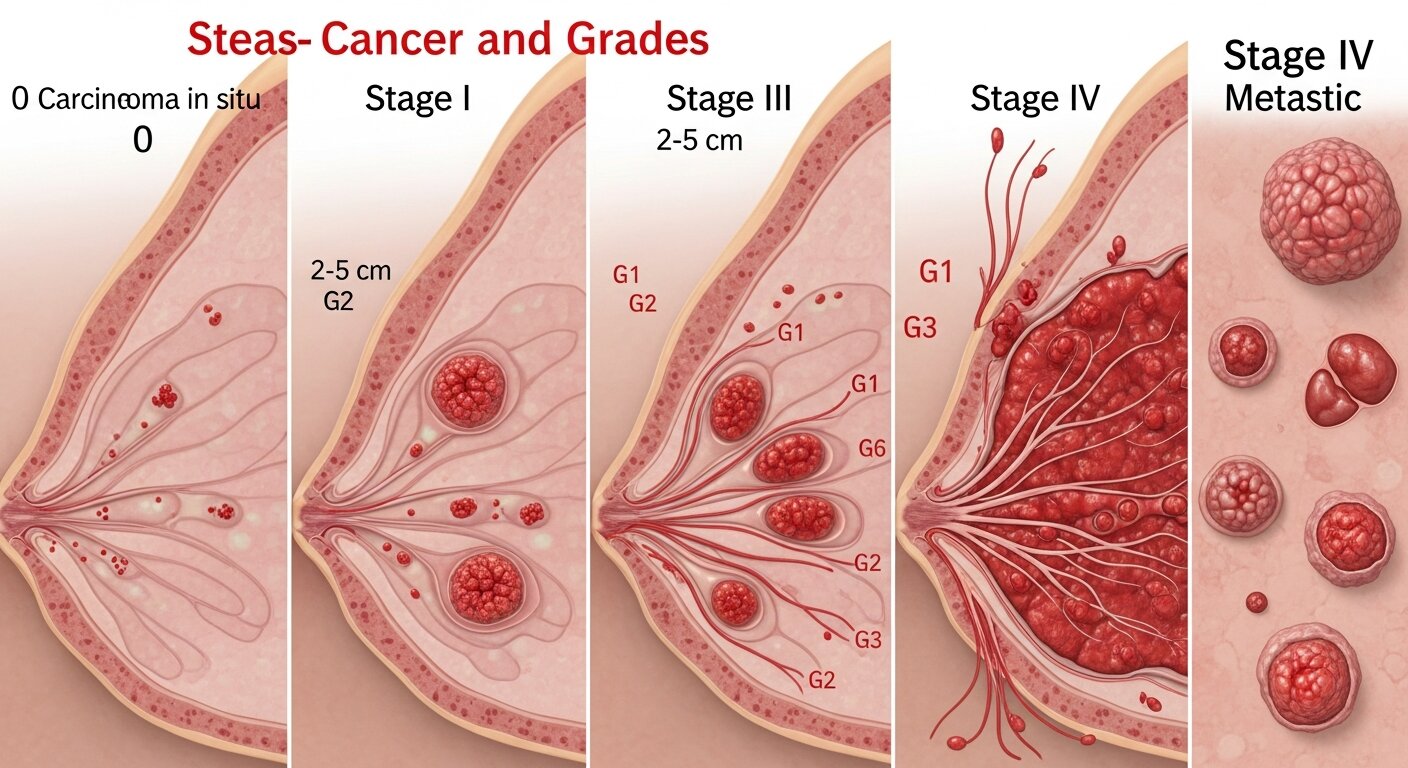
Once a diagnosis is confirmed, doctors determine the stage and grade of the cancer. These two distinct concepts describe how advanced the disease is and how quickly it is likely to grow. Staging and grading are critical components of the Breast Cancer Glossary, as they directly dictate your prognosis and the aggressive nature of the required treatments.
Deciphering the TNM System
Doctors universally use the TNM system to stage breast cancer. “T” stands for tumor size, “N” stands for lymph node involvement, and “M” stands for metastasis (whether the cancer has spread to distant parts of the body). By assigning numbers to each of these letters, your oncology team calculates an overall stage ranging from Stage 0 (non-invasive) to Stage IV (metastatic). Knowing your TNM status clarifies the rationale behind your specific medical plan.
Cancer Grades and Aggressiveness
While staging looks at the size and spread of the cancer, grading examines the cancer cells themselves. A pathologist grades breast cancer cells on a scale from 1 to 3 based on how much they look like normal cells. Grade 1 cells are well-differentiated and grow slowly. Grade 3 cells look highly abnormal and tend to grow rapidly and spread quickly. A higher grade often requires more immediate and intensive therapeutic interventions.
Treatment Options and Related Terminology
The treatment phase introduces a massive new vocabulary. From surgical procedures to systemic therapies, the terminology can be overwhelming. This section breaks down the standard treatments for breast cancer, helping you understand what each procedure entails and why your doctor might recommend one approach over another.
Surgery: Lumpectomy vs. Mastectomy
Surgery is often the first line of defense. A lumpectomy (breast-conserving surgery) removes the tumor and a small margin of surrounding healthy tissue, leaving the rest of the breast intact. A mastectomy removes the entire breast. The choice between these two procedures depends on the size of the tumor, the size of the breast, and the presence of genetic mutations.
|
Feature |
Lumpectomy |
Mastectomy |
|---|---|---|
|
Tissue Removed |
Only the tumor and a clear margin |
The entire breast tissue |
|
Recovery Time |
Generally shorter (1-2 weeks) |
Generally longer (4-6 weeks) |
|
Radiation Need |
Almost always required afterward |
Sometimes required, depending on spread |
|
Cosmetic Outcome |
Preserves the natural breast |
Requires reconstruction or prosthetics |
Radiation, Chemotherapy, and Targeted Therapy

Following surgery, you may need additional treatments to ensure all cancer cells are destroyed. Radiation therapy uses high-energy waves to target specific areas and kill remaining localized cancer cells. Chemotherapy uses powerful drugs to destroy rapidly dividing cancer cells throughout the whole body. Targeted therapy identifies and attacks specific proteins or genes that fuel cancer growth, offering a highly specialized approach with potentially fewer side effects than traditional chemotherapy.
Common Mistakes to Avoid When Reading Medical Reports
- Confusing Stage and Grade: Stage refers to the location and spread of the tumor, while grade refers to how abnormal the cells look and how fast they grow.
- Assuming all tumors are malignant: A tumor is simply a mass. Many breast tumors are benign (non-cancerous) fibroadenomas or cysts.
- Ignoring hormone receptor status: Failing to understand whether your cancer is ER-positive, PR-positive, or HER2-positive can cause confusion regarding why certain medications are prescribed.
Pro Tips for Navigating Terminology
- Request a printed copy: Always ask for a printed copy of your pathology report so you can highlight terms you do not recognize.
- Take notes during visits: Bring a notebook to your appointments and write down the exact words your doctor uses.
- Verify online sources: Use the vocabulary you learn here to conduct further research only on high-authority medical sites like the American Cancer Society.
Conclusion
Understanding your diagnosis begins with learning the language. We hope this Breast Cancer Glossary serves as a valuable tool during your medical journey. By breaking down complex terms into simple definitions, you can navigate your treatment plan with clarity and confidence. Bookmark this page for easy reference and discuss any confusing terms with your healthcare provider today.
Frequently Asked Questions
1. What is the definition of a benign breast tumor?
A benign breast tumor is a non-cancerous growth that does not invade nearby tissues or spread to other parts of the body. Common examples include cysts and fibroadenomas. Although usually not dangerous, some benign tumors may need monitoring or removal if they cause discomfort.
2. What does “malignant” mean in a breast cancer diagnosis?
Malignant means the tumor is cancerous. Malignant cells can grow uncontrollably, invade surrounding breast tissue, and potentially spread to other organs through the bloodstream or lymphatic system. These tumors usually require treatment such as surgery, radiation, or medication.
3. What is metastasis?
Metastasis happens when cancer cells break away from the original breast tumor and travel through blood vessels or lymph channels to other body parts. They may form new tumors in organs such as bones, liver, lungs, or brain. This is advanced cancer.
4. What does “in situ” mean?
“In situ” means “in its original place.” In breast cancer, it describes abnormal cells that remain confined within the milk ducts or lobules and have not spread into nearby breast tissue. An example is Ductal Carcinoma In Situ (DCIS).
5. How does a screening mammogram differ from a diagnostic mammogram?
A screening mammogram is a routine breast X-ray used for people without symptoms. A diagnostic mammogram is performed when there is a lump, pain, nipple discharge, or an abnormal screening result. It includes extra images and closer evaluation.
6. What are hormone receptors?
Hormone receptors are proteins found on some breast cancer cells that respond to estrogen or progesterone. If these receptors are present, the cancer is hormone receptor-positive. Such cancers may be treated with hormone-blocking therapies to slow or stop growth.
7. What does HER2-positive mean?
HER2-positive breast cancer has too much HER2 protein or extra copies of the HER2 gene, causing faster cell growth. This type can be more aggressive, but effective targeted treatments are available that specifically block HER2 signals and improve outcomes.
8. What is a clear margin in breast surgery?
A clear or negative margin means no cancer cells are found at the outer edge of tissue removed during surgery. This suggests the tumor was fully removed. If margins are positive, additional surgery may be recommended to remove remaining cancer cells.
9. What is the sentinel lymph node?
The sentinel lymph node is the first lymph node most likely to receive cancer cells from a breast tumor. Surgeons often test or remove this node during surgery to determine whether cancer has started spreading to the lymphatic system.
10. What is adjuvant therapy?
Adjuvant therapy is additional treatment given after the main treatment, usually surgery, to reduce the chance of cancer returning. It may include chemotherapy, radiation therapy, hormone therapy, immunotherapy, or targeted therapy depending on the cancer type and risk.
